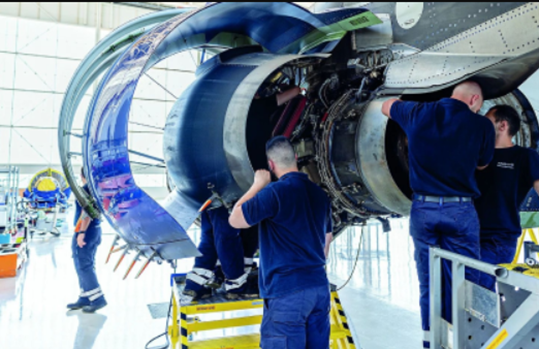
For an airline, every hour an aircraft spends on the ground is an hour it isn’t serving passengers or fulfilling its operational purpose. Yet heavy maintenance is unavoidable; engines, structures, and systems must be inspected, repaired, and certified on strict regulatory schedules. The challenge is not whether to maintain, but when, where, and how efficiently.
Today, fleet long-term heavy maintenance planning is an extraordinarily complex puzzle. Maintenance tasks carry individual due dates and regulatory intervals. Some tasks depend on others. MRO facilities differ in capacity, working hours, and cost. And the entire fleet must remain operationally available; you cannot ground half your aircraft at the same time. Planners rely on specialized tools and experience to navigate these constraints, yet the complexity of coordinating tasks, aircraft, and MRO facilities across multiple seasons leaves room for further efficiency gains in cost and aircraft ground time.
How UniMaaS Changes the Equation
The aircraft maintenance use case, developed by Aegean Airlines in partnership with the UniMaaS consortium, brings data-driven optimization to long-term heavy maintenance planning across three interconnected layers.
At the aircraft level, maintenance tasks are intelligently grouped into projects that respect task dependencies, regulatory intervals, and operational blackout periods, minimizing unnecessary early execution that would cause tasks to repeat sooner, consuming more materials and increasing labor cost or even introducing risks by increasing the chances of maintenance-induced failures.
At the fleet level, these projects are coordinated across all aircraft to ensure that the number of aircraft simultaneously in maintenance never exceeds operational limits.
Finally, at the MRO allocation level, each project is assigned to the most suitable facility, balancing cost, aircraft ground time, and production line continuity through what planners call nose-to-tail scheduling, where MRO bays are kept continuously occupied with back-to-back projects.
The platform also incorporates intent-based planning, allowing maintenance coordinators to express high-level goals that are automatically translated into precise optimization requirements, and AI-based estimators that predict task durations and resource needs from operational data.
Technical Foundation
The solution is built on scheduling algorithms across a planning horizon of one or more seasons. The solution is trained, validated, and benchmarked on representative operational data, ensuring that planning outputs reflect real-world fleet complexity. A Digital Product Passport for aircraft and aircraft parts supports traceability and circularity tracking throughout the maintenance lifecycle.
Impact
The outcomes of this use case extend well beyond a single airline. The planning framework developed here serves as a replicable blueprint for any asset-intensive industry. In these industries, long-term maintenance scheduling, resource allocation, and regulatory compliance must be balanced at scale. By demonstrating this approach, it shows how AI-driven, intent-based planning can reduce aircraft ground time. It also helps lower MRO costs. In addition, it maximizes the utilization of maintenance intervals through smarter task grouping. As a result, UniMaaS opens a path toward more sustainable industrial maintenance. It also enables more efficient operations. It further supports more resilient maintenance systems at large.
Blog Writers: Vana Kardasi, Christos Grigoras, Margarita Vitoropoulou
